Coinbase now counts several of the world’s largest banks, including J.P. Morgan, Citi, and Standard Chartered, as infrastructure partners. Is Coinbase becoming complementary to institutions like the custodians here, or a direct competitor to them?
It is absolutely a partner. In fact, one new piece of information is that of the world’s top 20 global systemically important banks (G-SIBs), seven of them have signed up to use our services. Not all of them are public, but I think you have the most relevant ones listed. I have been at Coinbase for around seven years, and in the early years there was this question of whether Coinbase was a threat or a partner. I think it is fair to say that collectively, the traditional finance world, the Wall Street world, viewed Coinbase as a competitor, mostly to their retail franchises.
Over the past four years, we have taken on quite a lot of these infrastructure partners. In the last couple of years, we’ve accumulated around 280 infrastructure clients, and those relationships cover all sorts of different institutions and infrastructure support.
Some of the banks initially focused on what the best pathway was to buy native crypto assets, things like Bitcoin. The exchange traded fund (ETF) chapter was the big acceleration of that because all the banking partners had to figure out how to merge the two worlds of crypto and traditional finance.
Now that we have moved on to the next chapter, I think the competitive threat on the consumer side has dissipated enormously. The consumer side will still compete for business, but Coinbase is increasingly viewed as an infrastructure partner to the banks. I would say most of them have concluded that it is better to partner than try to directly compete or build on their own.
The banks have working rails for trading financial assets at scale and doing global payments, but I think it is clear that we are going to live in a world of competing financial rails where the focus is on better, faster, and cheaper.
A lot of those partners have been working with us for all seven years. They have found that it is easier to partner with Coinbase and use our infrastructure rather than start from scratch themselves.
In that scenario, most of those banks are going to be protective of their end clients, and I want them to be because, for me, it is B2B2C. Citi is a good example. It has partnered with Coinbase to enable stablecoin payments globally. That means Citi clients have the ability to seamlessly convert their dollars at Citi into stablecoins, with the first version using USDC.
Crypto has been talking about payments as something that will revolutionise finance, but the challenge was that you had to live in two worlds. You still had to have cash in a bank and then a stablecoin, maybe on a crypto platform. This begins to solve that.
On the reverse side, Coinbase clients, merchants, and consumers can do the same thing.
Merchants can accept payments in stablecoins and convert them seamlessly to cash. So both Citi and Coinbase benefit enormously from a partnership that flows two ways.
How much of the current acceleration in institutional crypto adoption is down to the GENIUS Act and stablecoin regulatory clarity, versus underlying demand that would have shown up anyway?
I would say the vast majority of the enablement has come from GENIUS. I have been seeing it for a while. GENIUS was the big thing that put stablecoins into the main financial system. It was the thing that made the traditional finance world wake up.
If you were a sceptic sitting at one of those global investment banks, you could kind of scoff at the ETF moment as maybe just a one-off. Buying Bitcoin found its way through ETFs, but what happens next?
With GENIUS, and now the US taking the lead on stablecoin payments, it has been the wake-up call.
If you look at the biggest payments players in the world and the biggest global banks, those businesses are fundamental to the services they provide to global companies. So better, faster, and cheaper rails are a massive enablement.
The CLARITY Act did not pass, but Atkins came out immediately with rulemaking that would enable the next phase. It is important to flag that no one was holding their breath on CLARITY, so not a single thing in my pipeline has slowed.
In fact, much of it, strange but true, actually increased because of the announcements that came not even 48 hours after the CLARITY news.
Mubadala’s tokenised credit fund — what does that tell us about which institutions are actually furthest along: sovereign wealth funds, traditional asset managers, or banks?
The United Arab Emirates (UAE) hoisted its flag to be the digital centre of global commerce three or four years ago, and since then they have done quite a lot of enablement on blockchain. They were particularly front-footed during the Gensler administration, and it is true to say that innovation was moving abroad.
When the UAE and the crypto world thought about things like democratisation of assets, giving access to things that a normal person cannot get, one of the trophy assets of sovereign wealth funds is their core holdings.
The Mubadala credit fund arguably has some of the best and biggest-performing assets in the world in terms of its portfolio. But because it is a sovereign wealth fund, that portfolio wasn’t an option for outsiders to invest in.
As sovereign wealth funds look at their portfolios and want to be able to open them up, this was a really big deal. That is a giant first step for putting a sleeve of the credit fund on blockchain rails with Coinbase, and that probably is a precursor to opening it up later and perhaps having UAE residents get the opportunity to co-invest alongside the sovereign wealth fund.
We are also regulated by the Virtual Assets Regulatory Authority (VARA) through our Deribit acquisition and by Abu Dhabi Global Market (ADGM). We have launched tokenised stocks in ADGM, which is a big deal. We have 10 tickers live, including the ones you would think of — Tesla, Microsoft, Amazon, Google, and Strategy — and there are more to come.
What is interesting about that launch is that, differently to some other products, when you buy the tokenised stock, it actually represents ownership of the underlying stock.
It is very similar to how an US American Depositary Receipt (ADR) works, where there is a stock held at a reputable custodian and they issue a depository receipt that represents real ownership in the underlying stock. So things like dividend payments and voting rights actually pass through to the end investor.
PNC now offers Bitcoin trading to its wealth clients through your infrastructure. How does the infrastructure-as-a-service model reshape who owns the client relationship in digital assets?
That is an important one because PNC was a very early adopter in wanting to launch the ability for its clients to own Bitcoin. The way it works is consistent with our broader infrastructure strategy, where PNC continues to own the client relationship and we are the infrastructure behind the scenes. Their clients have the ability to seamlessly buy Bitcoin.
My guess is that Debbie, their chief technology officer, and Bill Demchak, their CEO, have very progressive views on how to enable their total client network — including their corporations — to do things like cross-border transactions and stay open more than traditional markets allow.
You have argued that existing financial system rules can be adapted to govern AI agents and autonomous transactions rather than rebuilt from scratch. What is the biggest gap regulators still need to close?
It feels like a hard question to answer, but what I would reflect on is that right now, as a Coinbase client, you can already begin to use agents on your behalf.
You can connect to Coinbase and, if you happen to be more at the progressive end of technology and you have already been using some agentic solutions, you can plug your agent in and begin to employ things like trading models, tax-loss harvesting, momentum models, systematic models, and trend-following models.
A lot of those are what traditional finance might call self-directed. Coinbase is not saying you have to use one method by which you enable agentic trading. I think all of the lessons learnt that begin to accrue from now can be good input into the next phase.
The way the financial services world works is that either you manage your own money and you’re a self-directed investor, or you hire someone else who’s a fiduciary, so they have to act on your behalf.
One of the really cool things that we are working on is called Coinbase Advisor, which was launched in June. It is in its very early stages. You will be able to engage with it and say: ‘Here are my portfolio holdings. What do you think?’
You could say: ‘I think I’m going to own my Bitcoin for a while. Even though it’s a hyper-liquid asset, I intend on owning it for a while. What can I do to generate some income while I’m otherwise holding it?’
Coinbase Advisor will have the ability to tee up a recommendation and a method by which you can begin to do things like basis trading or call overwriting. You can employ a model and that model will then deploy the trading strategy according to your direction.
I think those agents will begin to manifest quite a lot faster than everyone expects, and that is why a lot of our leading-edge technologists and developers are applying their efforts there.
After 17 years at Barclays in traditional markets, what is the one lesson from that world that the crypto industry still has not learnt?
With 17 years at Barclays and 10 years at J.P. Morgan, I think one lesson from that world to bring here is that you need to really consider your clients and their needs and build products that suit their needs.
Reflecting over seven years of building, one of the things I am really proud of is that I wanted to get to a point, which happened a couple of years ago, where a client said: “Brett, this feels just like trading stocks. This feels just like trading any other asset in my portfolio, because I can buy it, sell it, safely store it, get cross-margin financing, trade spot, derivatives, etc.”
In the next phase, if you think about the big picture of the tokenisation of assets, you have got a massive world. It is something like US$400 trillion in assets, and crypto is maybe not even one per cent of it.
As crypto thinks about how to come into this world, we need to satisfy everything and make sure that all of the flows work front to back. Reverse it, try it out — it needs to fit seamlessly.
As crypto wants to begin to push the envelope of disrupting how things work, I think we have to pay homage to the fact that the financial system has been up and running and functional, supporting massive trade volumes and making sure that all those client journeys are seamless.
With crypto and digital assets, you have had to learn something new, and it takes a long time for banks and clients to do something entirely new.
Being able to integrate Coinbase infrastructure into that system, taking into account client needs, is probably the number one thing.
Next interview →
Calastone
Simon Keefe


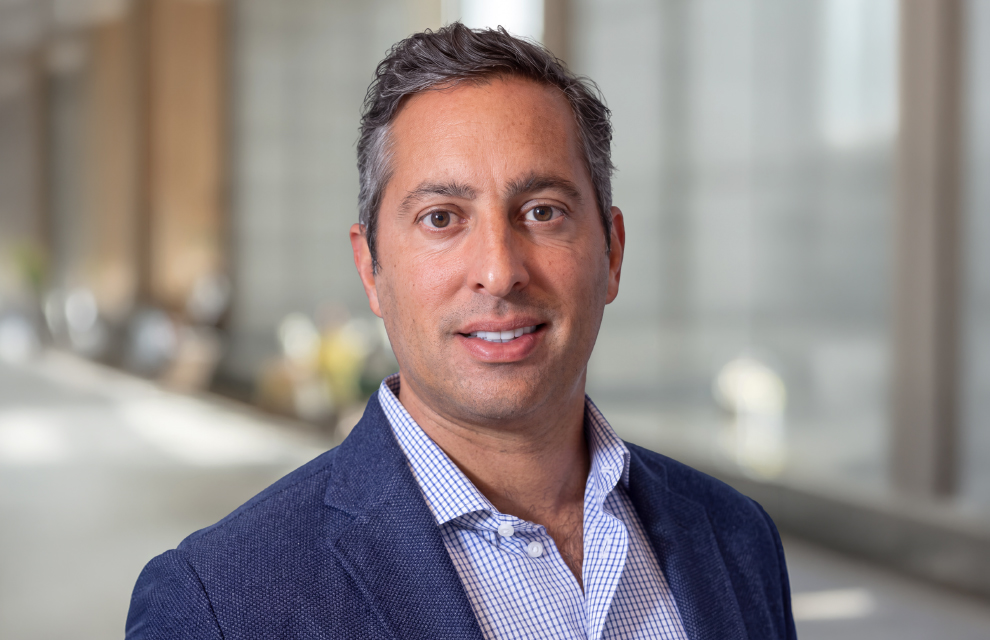 Image: Coinbase Institutional